The word stracciatella appears on gelato menus, cheese boards, and soup bowls — and it means something completely different in each context. This guide covers all three, explains the shared thread that connects them, and shows you how to make each one at home.
Thank you for reading this post, don't forget to subscribe!What Is Stracciatella?
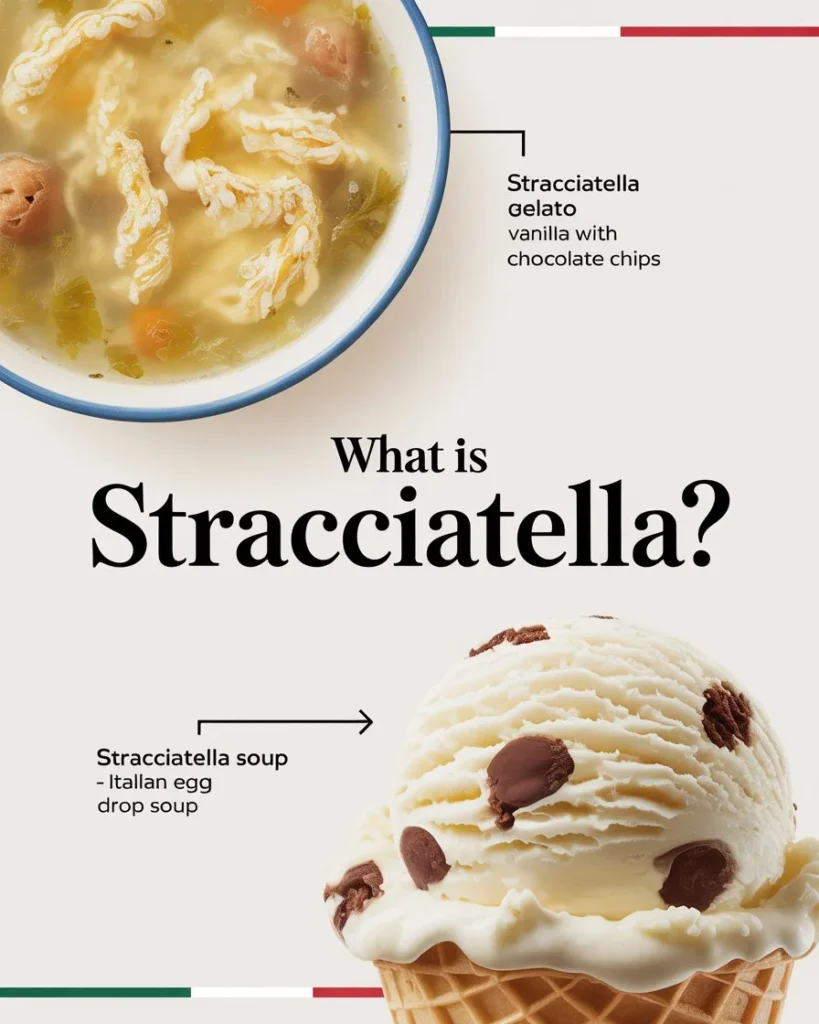
Stracciatella is an Italian word that comes from stracciare — meaning “to tear” or “to shred.” It refers to three distinct Italian foods that share one common technique: something is drizzled, torn, or shredded into something else to create irregular, ribbon-like streaks.
The three forms of stracciatella are:
- Stracciatella cheese — a fresh Italian cheese made from shredded mozzarella curds mixed with cream, originating from Puglia in southern Italy
- Stracciatella gelato — an Italian ice cream flavored with fine chocolate shards created by drizzling melted chocolate into churning gelato, where it shatters into irregular pieces
- Stracciatella soup — a Roman egg-drop soup made by drizzling beaten eggs into hot broth, where they cook into delicate, ragged strands
All three are named for the same visual quality: the torn, shredded, irregular texture that defines each dish. Understanding that one word and what it represents unlocks the logic of all three recipes immediately.
How to Pronounce Stracciatella
Before anything else — because this word stops a lot of people before they’ve even ordered it.
Stracciatella is pronounced:
strach-ya-TEL-la
Broken down syllable by syllable:
- Stra — like “stra” in “straw”
- ccia — pronounced “cha” (the double c before i in Italian makes a “ch” sound)
- tel — like “tell”
- la — like “la” in “lah”
Full pronunciation: strach-ya-TEL-la
The stress falls on the third syllable — TEL. The double “c” followed by “i” is the part that trips most English speakers. In Italian, “cci” is always pronounced as a hard “ch” sound — think cappuccino (cap-pu-CHEE-no), where the same rule applies.
A useful memory trick: say “straw-cha-TELL-a” slowly, then speed it up. That’s close enough that any Italian barista, cheesemonger, or waiter will know exactly what you’re asking for.
What Is Stracciatella Cheese?
Stracciatella cheese is a fresh Italian cheese from the Puglia region of southern Italy — the heel of the boot. It is made from the same curd as mozzarella but processed differently: the curds are stretched and torn into long, thin strands (stracciata — torn), then mixed with fresh cream to create a loose, spoonable, extraordinarily rich cheese.
It has the texture of very soft, stringy burrata filling — which makes sense, because stracciatella is literally what goes inside a burrata. When you cut open a ball of burrata and the creamy interior spills out, that interior is stracciatella.
What Does Stracciatella Cheese Taste Like?
Stracciatella cheese is:
- Milky and fresh — clean dairy flavor without sharpness or aging
- Rich and creamy — the cream mixed in makes it significantly more indulgent than plain mozzarella
- Slightly tangy — a gentle lactic acidity that keeps the richness from being cloying
- Delicately salty — just enough to enhance the milk flavor
The texture is the defining characteristic — loose strands of fresh mozzarella suspended in cream, with a consistency somewhere between ricotta and very soft pulled cheese. It melts on the tongue rather than requiring chewing.
Where Does Stracciatella Cheese Come From?
Stracciatella di bufala originates from Andria, a city in the Apulia (Puglia) region of southern Italy. The area is historically famous for its dairy production — particularly buffalo mozzarella — and stracciatella developed as a natural extension of the mozzarella-making process, using the same curds but transforming them through cream into something even more luxurious.
Traditional Puglian stracciatella is made from buffalo milk, though cow’s milk versions (fior di latte stracciatella) are now widely produced and more commonly found outside Italy.
How to Use Stracciatella Cheese
Stracciatella cheese is a fresh cheese meant to be eaten immediately or within 2–3 days of production. Its delicate flavor and loose texture make it ideal for:
| Use | How to Serve |
|---|---|
| On pizza | Spoon over a freshly baked Neapolitan base just before serving — the heat from the pizza warms it without cooking it |
| On bruschetta | Spread over grilled bread with cherry tomatoes, basil, and a drizzle of good olive oil |
| In salads | Spoon alongside heirloom tomatoes with torn basil and aged balsamic |
| On pasta | Dolloped over finished pasta dishes — particularly with roasted tomatoes or pesto |
| On flatbreads | Spread as a base layer with toppings added after baking |
| Eaten simply | With good bread, olive oil, flaky sea salt, and black pepper — nothing else needed |
Also Read: Low Calorie Starbucks Drinks
The cardinal rule with stracciatella cheese: never cook it. Heat destroys both its texture and its delicate flavor. Always add it at the very end — after cooking, after baking, after plating. The residual warmth of the dish is all it needs.
How to Make Stracciatella Cheese at Home
Making stracciatella at home requires either fresh mozzarella curd (available from specialty Italian food suppliers or some farmers markets) or a willingness to make mozzarella from scratch first. The process itself is simple once you have the curd.
Ingredients:
- 500g fresh mozzarella curd (or stretch your own from curd)
- 200ml fresh heavy cream (the best quality you can find)
- 1–2 tsp fine sea salt
- Optional: a drizzle of extra virgin olive oil to finish
Instructions:
Step 1: Heat the curd. Bring a large pot of water to approximately 85°C (185°F) — hot but not boiling. Add 1 tbsp salt to the water. Cut the mozzarella curd into small chunks and submerge in the hot water. Let sit 2–3 minutes until the curd becomes soft and pliable.
Step 2: Stretch and tear. Using two forks or your hands (wear food-safe gloves — the water is very hot), pull and stretch the softened curd into long, thin strands. Don’t try to make them uniform — irregular, torn pieces are the point. The strands should be roughly the thickness of thick noodles.
Step 3: Transfer to cold water. Move the stretched strands immediately to a bowl of cold water to stop cooking and set the texture. Let cool completely, about 5 minutes.
Step 4: Drain and combine with cream. Drain the strands thoroughly and place in a bowl. Add the cold heavy cream and salt. Toss gently to combine — you want the cream to coat and permeate the strands without breaking them down into a paste.
Step 5: Taste and adjust. Taste for salt. The cheese should be gently, pleasantly salty. Add more salt if needed.
Serve immediately or refrigerate for up to 2 days in an airtight container, submerged in the cream mixture. The flavor and texture are best on the day of making.
Calories per serving (~80g): ~220 cal
What Is Stracciatella Gelato?
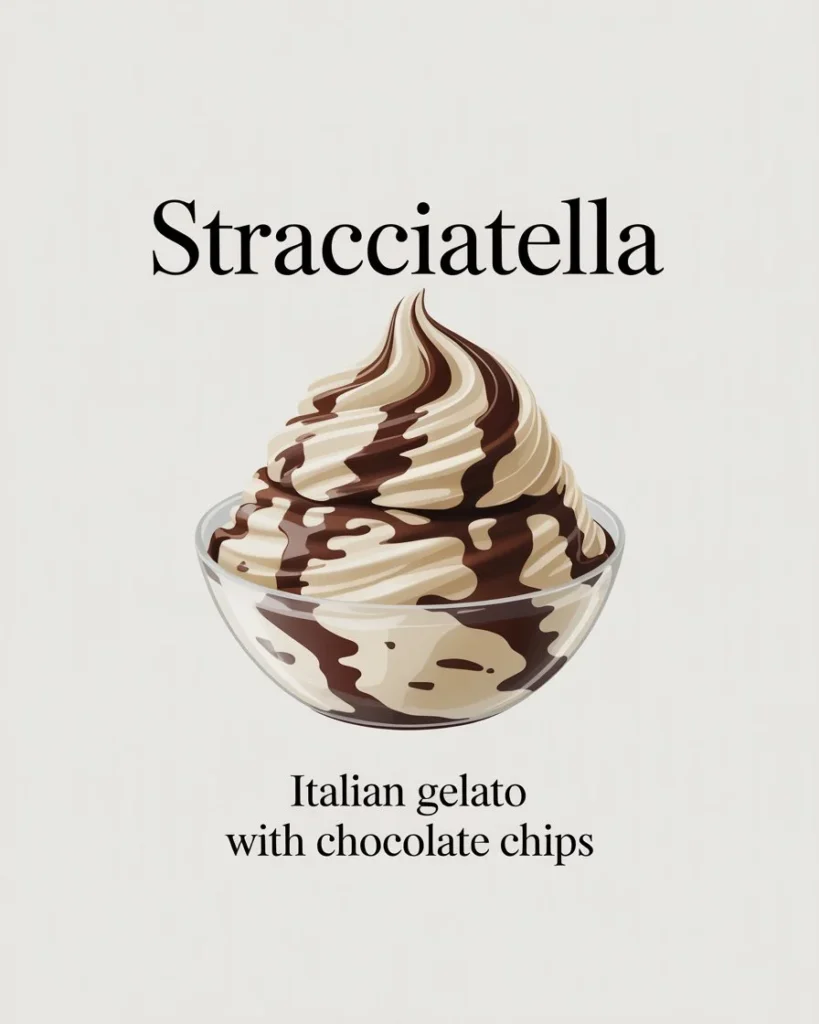
Stracciatella gelato is an Italian ice cream flavor created in Bergamo, in the Lombardy region of northern Italy, in 1961 by Enrico Panattoni at his gelateria La Marianna. The flavor was an instant success and spread rapidly throughout Italy before becoming one of the most recognized gelato flavors in the world.
It consists of a simple, clean cream-flavored gelato base — fior di latte (flower of milk) — laced with fine, irregular chocolate shards created by drizzling liquid dark chocolate directly into the churning gelato, where the cold temperature causes it to harden instantly and shatter into thin, crispy pieces on contact with the churning paddle.
The result is a white, creamy gelato studded with irregular dark chocolate fragments — not chocolate chips (which are too uniform and too thick), but delicate, paper-thin shards that melt immediately when they hit your tongue, releasing a burst of dark chocolate against the cool cream.
What Does Stracciatella Gelato Taste Like?
The flavor is clean and elegant:
- The base: Pure, fresh dairy — sweet, cold, milky, and not overly rich. The fior di latte base is deliberately mild so the chocolate can speak.
- The chocolate: Thin dark chocolate shards that melt instantly, delivering an immediate hit of bitter cocoa that contrasts beautifully with the sweet cream.
- Together: The combination is greater than either element alone — the interplay between the cold, sweet cream and the snapping, bitter chocolate is what makes stracciatella gelato one of the most satisfying flavors in the gelato canon.
Stracciatella Gelato vs. Chocolate Chip Ice Cream
These look similar but are fundamentally different products:
| Stracciatella Gelato | Chocolate Chip Ice Cream | |
|---|---|---|
| Base | Fior di latte (cream, milk, minimal eggs) | Typically vanilla custard (egg yolks, heavy cream) |
| Chocolate | Fine, irregular shards drizzled in during churning | Uniform pre-formed chips folded in |
| Chocolate texture | Paper-thin, melts instantly on tongue | Thicker, more noticeable chew |
| Air content | Lower (gelato has less overrun) | Higher — more airy texture |
| Temperature served | Warmer than ice cream (~-11°C / 12°F) | Colder (-15 to -18°C / 5 to 0°F) |
| Mouthfeel | Denser, silkier, more intense | Lighter, colder, more frozen |
| Origin | Bergamo, Italy, 1961 | American commercial tradition |
The key distinction is the chocolate application method. In stracciatella gelato, the chocolate is drizzled as a liquid into moving gelato — the cold shatters it into irregular shards as thin as paper. In commercial chocolate chip ice cream, pre-formed chips are simply stirred in. The resulting texture experience is entirely different.
How to Make Stracciatella Gelato at Home
You can make authentic stracciatella gelato at home with or without an ice cream machine. The without-machine method requires more patience but produces excellent results.
With an Ice Cream Machine
Ingredients (serves 6):
For the fior di latte base:
- 500ml whole milk (full fat)
- 200ml heavy cream
- 150g caster sugar
- 30g skimmed milk powder (improves texture — not optional)
- 1 tsp vanilla extract
- Pinch of fine salt
For the chocolate drizzle:
- 100g good quality dark chocolate (70% cocoa), finely chopped
- 1 tsp neutral oil (sunflower or coconut) — helps the chocolate stay liquid longer for thinner shards
Instructions:
Step 1: Make the base. Whisk together milk, cream, sugar, milk powder, vanilla, and salt in a saucepan over medium heat. Warm gently until the sugar and milk powder are fully dissolved — do not boil. Remove from heat and allow to cool completely. Refrigerate for at least 4 hours or overnight — a cold base churns significantly better.
Step 2: Churn. Pour the cold base into your ice cream machine and churn according to the manufacturer’s instructions — typically 20–30 minutes, until the gelato reaches a thick, soft-serve consistency.
Step 3: Make the chocolate drizzle. In the final 2–3 minutes of churning, melt the chocolate with the neutral oil in a small bowl over hot water or in 20-second microwave bursts. Stir until completely smooth. Allow to cool to about 40°C (104°F) — warm enough to pour but not so hot it melts the gelato.
Step 4: Drizzle into the churning gelato. With the machine still running, slowly drizzle the liquid chocolate in a thin, steady stream directly into the churning gelato. The cold temperature shatters it immediately into fine shards. The key is drizzling slowly and thinly — too thick a stream creates large chunks rather than fine shards.
Step 5: Transfer and firm. Transfer the gelato to a shallow, wide container (wide containers freeze more evenly than deep ones). Press parchment directly onto the surface to prevent ice crystals forming. Freeze for at least 2–3 hours before serving.
Step 6: Temper before serving. Remove from the freezer 5–10 minutes before serving. Authentic gelato is served at a warmer temperature than ice cream — this softer temperature is part of what makes the texture so silky.
Calories per serving: ~280
Without an Ice Cream Machine (No-Churn Method)
Ingredients:
- 300ml heavy cream, very cold
- 200ml sweetened condensed milk
- 1 tsp vanilla extract
- 80g dark chocolate (70%), melted with 1 tsp neutral oil
Instructions:
- Whip cold heavy cream to soft peaks — not stiff, just holding shape.
- Fold in condensed milk and vanilla gently until combined.
- Pour into a shallow freezer-safe container. Freeze 2 hours until partially set but still soft in the center.
- Remove from freezer. Working quickly, drizzle melted chocolate in thin streams over the surface. Use a skewer or knife to fold and swirl the chocolate through the gelato in 3–4 gentle strokes — don’t overmix.
- Return to freezer for at least 4 hours until fully set.
- Temper 5–10 minutes before serving.
Note: The no-churn method produces slightly larger chocolate pieces than the machine method, but the flavor is excellent and the technique is far more accessible.
What Is Stracciatella Soup?
Stracciatella soup (stracciatella alla romana) is a traditional Roman soup made by beating eggs with Parmesan cheese and drizzling them into simmering broth, where they cook instantly into delicate, irregular strands — the stracciata (torn, shredded) threads that give the soup its name.
It is the Italian answer to Chinese egg drop soup — elegant in its simplicity, deeply comforting, and ready in under 10 minutes. In Rome, it has been a staple of home cooking for centuries, served as a first course (primo piatto) and particularly popular during winter and Easter.
What Does Stracciatella Soup Taste Like?
At its best, stracciatella soup tastes like pure comfort:
- The broth — rich, golden, deeply savory (the quality of the broth is everything)
- The egg strands — delicate, tender, slightly silky — they absorb the broth flavor and add body without heaviness
- The Parmesan — nutty and savory, integrated both into the eggs and sprinkled over at the end
- The nutmeg — a barely-there warmth that lifts the whole dish
It is a soup built entirely on quality of ingredients rather than complexity of technique. A mediocre broth produces a mediocre stracciatella. A great homemade broth produces one of the most satisfying bowls of soup you will ever eat.
How to Make Stracciatella Soup
Ingredients (serves 4):
- 1.5 liters high-quality chicken or beef broth (homemade strongly preferred — the soup lives or dies by the broth)
- 4 large eggs
- 60g Parmesan cheese, freshly grated (plus extra for serving)
- Fresh nutmeg, grated — just a few passes on the grater
- Salt and white pepper
- Optional: 2 tbsp fine semolina or breadcrumbs (traditional Roman addition that gives the egg mixture more body)
- Optional: fresh spinach or small pasta (pastina) for a heartier version
Instructions:
Step 1: Heat the broth. Bring the broth to a gentle simmer in a wide saucepan — not a rolling boil, just a quiet, active simmer. Taste it. If it isn’t deeply flavorful and well-seasoned, add salt and simmer 5 more minutes. The broth sets the ceiling for how good this soup can be.
Step 2: Make the egg mixture. In a bowl, beat the eggs thoroughly with the Parmesan, a few gratings of fresh nutmeg, and a pinch of white pepper. If using semolina or breadcrumbs, whisk them in now — they give the egg strands more structure and a slightly thicker texture, which is the traditional Roman style.
Step 3: Create the strands. With the broth at a gentle simmer, pour the egg mixture in a slow, steady stream from a height of about 20–25cm above the pot — this height helps the eggs spread into thin strands rather than clumping. As you pour, use a fork or whisk to stir the broth in slow, wide circles. The eggs will cook almost instantly into delicate, feathery strands.
Step 4: Don’t over-stir. Stir gently for 60–90 seconds only. Over-stirring breaks the strands too small and makes the soup cloudy and texture-less. You want visible strands — not scrambled egg particles.
Step 5: Serve immediately. Ladle into warm bowls. Finish with freshly grated Parmesan, a few drops of good olive oil, and a final grating of nutmeg. Serve at once — stracciatella soup does not hold well, as the egg strands continue cooking in the hot broth.
Calories per serving: ~180
Tips for the Best Stracciatella Soup
The broth is 80% of the dish. If you have time, make a proper chicken broth from scratch — a whole chicken simmered with onion, carrot, celery, peppercorns, and a bay leaf for 2–3 hours produces a broth of a completely different quality than anything from a carton. That said, a good quality store-bought low-sodium broth, enhanced with a Parmesan rind simmered in it for 20 minutes, gets you surprisingly close.
Use freshly grated Parmesan only. Pre-grated Parmesan has cellulose added to prevent clumping — it doesn’t melt or incorporate the same way. Buy a block and grate it fresh.
Pour from height. The 20–25cm drop between the bowl and the broth surface helps the egg mixture spread into fine strands as it hits the liquid. Pour too close and the eggs clump.
Serve immediately. Stracciatella soup waits for no one. The moment you ladle it, the egg strands are continuing to cook in the hot liquid. Serve it fast and eat it hotter than you think.
The Three Stracciatella: A Summary
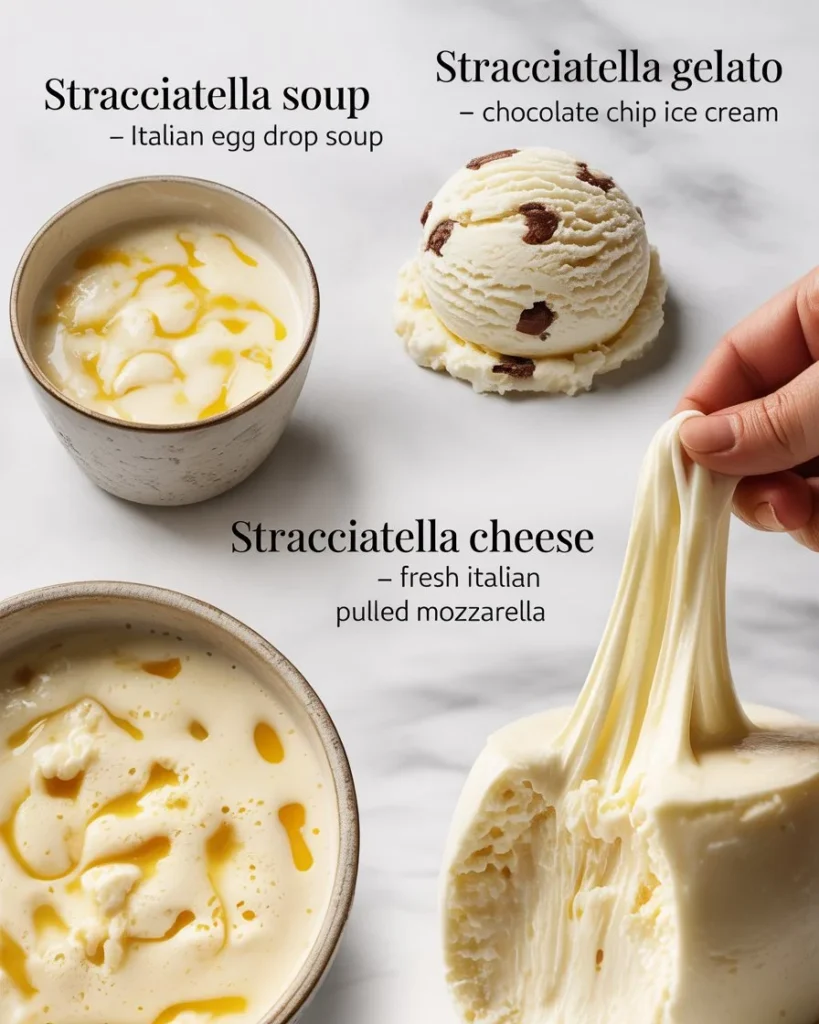
| Stracciatella Cheese | Stracciatella Gelato | Stracciatella Soup | |
|---|---|---|---|
| Origin | Puglia, southern Italy | Bergamo, northern Italy (1961) | Rome, central Italy |
| The “tearing” | Mozzarella curds stretched into strands | Chocolate drizzled into gelato, shattering into shards | Eggs drizzled into broth, forming torn strands |
| Main ingredients | Mozzarella curd + fresh cream | Milk, cream, sugar + dark chocolate | Broth + eggs + Parmesan |
| Served | Cold, fresh, immediately | Cold, slightly warmer than ice cream | Hot, immediately |
| Best with | Pizza, bruschetta, tomatoes | On its own or with a simple wafer | As a starter course |
| Shelf life | 2–3 days refrigerated | 1–2 weeks frozen | Serve immediately |
| Skill level | Intermediate (requires curd) | Easy–Intermediate | Very easy |
Also Read: Healthy Shrimps Recipe
Frequently Asked Questions
What is the difference between stracciatella and burrata? Burrata is a whole cheese — a pouch of fresh mozzarella filled with stracciatella and sealed. When you cut into burrata, the stracciatella spills out. Stracciatella is the interior filling: shredded mozzarella strands mixed with fresh cream. You can buy stracciatella on its own as a standalone cheese, or you can simply cut open a burrata. The flavor and texture are identical — the difference is purely one of presentation and format.
Is stracciatella cheese the same as ricotta? No — they are very different cheeses. Ricotta is made from whey (the liquid left over from making other cheeses) and has a grainy, cottage-cheese-like texture. Stracciatella is made from stretched mozzarella curds combined with cream and has a stringy, silky texture. They are used differently, taste different, and have different origins. The only thing they share is that both are fresh, unaged Italian cheeses.
Where can I buy stracciatella cheese? Stracciatella cheese is available at Italian specialty food stores, good delis, some supermarket cheese counters, and online Italian food retailers. It’s typically sold in small tubs packed in its own cream. If you can’t find it, high-quality fresh burrata (cut open) or very fresh buffalo mozzarella torn and mixed with a little heavy cream is a workable substitute.
Why is stracciatella gelato white with chocolate, not chocolate ice cream? The base of stracciatella gelato is fior di latte — a pure milk and cream base with no chocolate in it. The chocolate component comes entirely from the shards drizzled in during churning. The contrast between the white cream base and the dark chocolate shards is a defining visual and flavor characteristic of the gelato. It is emphatically not chocolate ice cream with cream swirled through it.
Can stracciatella soup be made vegetarian? Yes — substitute a high-quality vegetable broth for the chicken or beef broth. The egg and Parmesan components are already vegetarian. For a fully vegetarian result, use a vegetable broth fortified with Parmesan rinds simmered in it for 20–30 minutes — this adds the depth and umami that chicken broth normally provides.
What’s the best chocolate to use for stracciatella gelato? Use a good quality dark chocolate with 65–75% cocoa solids. Higher percentage chocolate (85%+) can be too bitter and the shards lack the snap that comes from the cocoa butter in a standard dark chocolate. Avoid milk chocolate — it’s too sweet and produces a different flavor profile entirely. The brand matters here — use couverture chocolate if possible, as its higher cocoa butter content produces thinner, crisper shards.
The Bottom Line
Stracciatella is a word that rewards knowing. Once you understand what it means — that something is torn, shredded, or drizzled to create irregular, textured streaks — the three very different foods it describes suddenly make perfect sense. A fresh cheese of torn mozzarella threads in cream. A gelato of shattering chocolate drizzled through cold cream. A soup of feathery egg strands rippling through golden broth.
Same word, same technique, three completely different pleasures — all of them distinctly, unmistakably Italian.
Now you can order it, pronounce it, and make it from scratch. The only thing left to do is decide which version to try first.
Have you tried all three forms of stracciatella? Tell us your favorite in the comments — and whether you’ve ever made any of them at home.