Whether you just unboxed your first slow cooker or dusted off one that’s been sitting in your cabinet for years — this guide walks you through everything you need to know to cook confidently, safely, and deliciously.
Thank you for reading this post, don't forget to subscribe!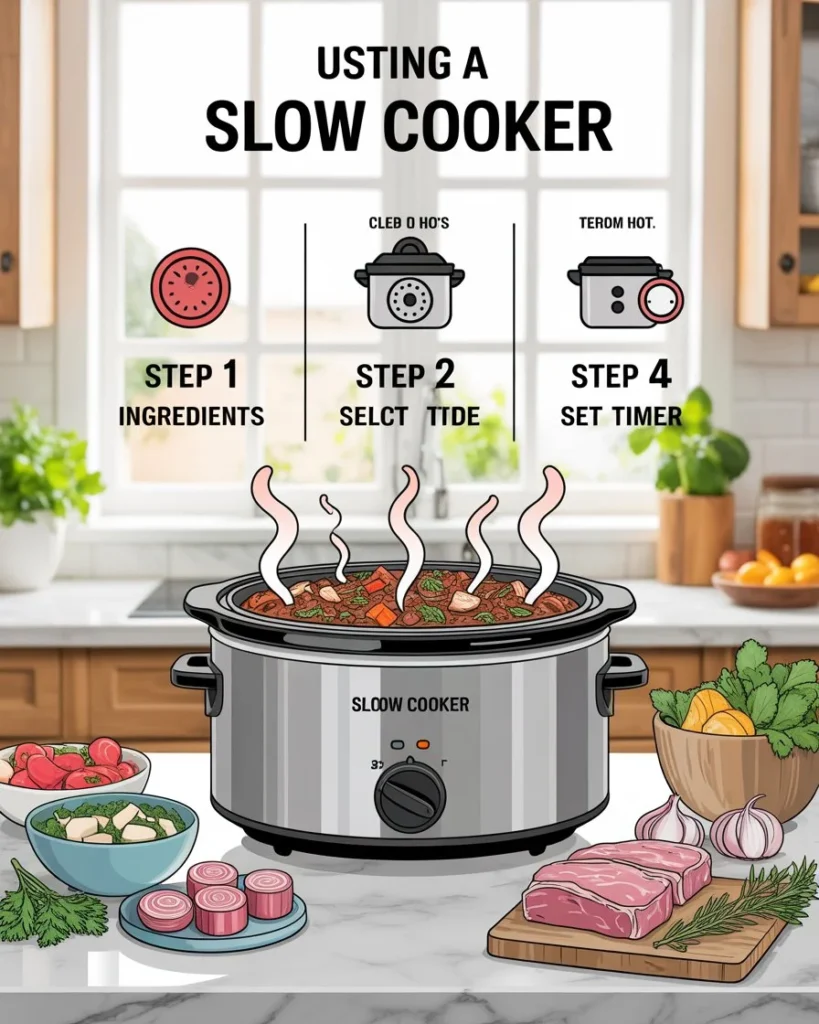
What Is a Slow Cooker and Why Should You Use One?
A slow cooker (often called a Crock-Pot, which is actually a brand name) is a countertop electric appliance that cooks food at low temperatures over a long period of time — usually anywhere from 4 to 10 hours. It uses moist heat trapped under a lid to slowly break down ingredients, develop deep flavors, and tenderize even the toughest cuts of meat.
Here’s why millions of home cooks swear by it:
- Hands-off cooking — You prep, you set, you walk away.
- Budget-friendly meals — Cheap cuts of meat (like chuck roast or chicken thighs) shine in a slow cooker.
- Meal prep powerhouse — One batch can feed a family for days.
- Energy efficient — Uses far less electricity than a conventional oven.
- Hard to mess up — Low and slow is forgiving, even for beginners.
Understanding Your Slow Cooker: Parts & Settings
Before you start cooking, get familiar with your appliance.
Main Components
- Ceramic or stoneware insert — The removable inner pot where food goes. Most are dishwasher safe.
- Glass lid — Traps steam and moisture. Resist the urge to lift it while cooking (more on that below).
- Heating base — The outer shell with the heating element and controls.
Heat Settings
Most slow cookers have three basic settings:
| Setting | Temperature Range | Best For |
|---|---|---|
| Low | ~170–200°F (77–93°C) | Long cooks (6–10 hours), tougher cuts of meat |
| High | ~200–300°F (93–149°C) | Faster cooks (3–4 hours), soups, vegetables |
| Warm | ~145°F (63°C) | Keeping food hot after cooking — NOT for cooking raw food |
Rule of thumb: 1 hour on High ≈ 2 hours on Low.
How to Use a Slow Cooker: Step-by-Step
Step 1: Choose the Right Recipe
Not everything works well in a slow cooker. The best slow cooker ingredients include:
- Proteins: Chicken thighs, beef chuck, pork shoulder, lamb shanks, dried beans, lentils
- Vegetables: Root vegetables (carrots, potatoes, onions, parsnips) hold up well. Add delicate greens (spinach, zucchini) in the last 30 minutes.
- Liquids: Broths, sauces, canned tomatoes, coconut milk
Avoid cooking these in a slow cooker:
- Chicken breasts (they dry out easily unless submerged in liquid)
- Pasta and rice (add in the last 30–45 minutes)
- Dairy products like milk or cream (add near the end to prevent curdling)
- Frozen meat (always thaw first for food safety)
Step 2: Prep Your Ingredients
Good prep makes all the difference.
- Trim excess fat from meat. Fat doesn’t render the same way it does in a hot oven, and you’ll end up with a greasy dish.
- Chop vegetables uniformly so they cook evenly. Root vegetables take longer, so cut them smaller or place them at the bottom of the pot (closest to the heat).
- Brown your meat first (optional but highly recommended). Searing meat in a pan for 2–3 minutes per side before adding it to the slow cooker adds a deep, caramelized flavor that you simply can’t get otherwise. It takes an extra 10 minutes and is 100% worth it.
- Layer correctly: Dense ingredients (root veggies, beans) go on the bottom. Meat goes on top or in the middle. Liquids go last.
Step 3: Add Liquid — But Not Too Much
This is the most common mistake beginners make: adding too much liquid.
Since the slow cooker lid traps steam, very little moisture escapes during cooking. Unlike a stovetop or oven, liquids don’t evaporate much. Start with less than you think you need — most recipes need only ½ to 1 cup of liquid unless it’s a soup or stew.
A good guideline:
- Soups & stews: Fill up to ¾ full with liquid.
- Braised meats: Just enough liquid to come halfway up the sides of the meat.
- Sauces & dips: Follow the recipe closely.
Step 4: Set It and (Actually) Forget It
Once your ingredients are in and the lid is on, set your temperature and let it do its thing.
Do not lift the lid during cooking. Every time you lift the lid, the slow cooker loses heat and adds 15–20 minutes to your cook time. Trust the process.
Here are general cook time guidelines:
| Food | Low Setting | High Setting |
|---|---|---|
| Whole chicken | 6–8 hours | 3–4 hours |
| Beef chuck roast | 8–10 hours | 4–6 hours |
| Pork shoulder | 8–10 hours | 5–6 hours |
| Chicken thighs | 6–8 hours | 3–4 hours |
| Lentil soup | 6–8 hours | 3–4 hours |
| Vegetable curry | 4–6 hours | 2–3 hours |
Step 5: Taste, Adjust, and Finish
When the cook time is up, lift the lid and taste your dish. Here’s how to adjust:
- Too bland? Add salt, a squeeze of lemon juice, or fresh herbs. Fresh flavors added at the end brighten everything up.
- Too thin? Remove the lid, turn to High, and let it cook uncovered for 20–30 minutes to reduce. Or mix 1 tablespoon of cornstarch with 2 tablespoons of cold water and stir it in — it’ll thicken within minutes.
- Too thick? Add a splash of broth or water and stir.
- Meat not tender enough? It needs more time. Put the lid back on and cook for another hour.
Slow Cooker Food Safety: What You Need to Know
Food safety is non-negotiable. Follow these rules:
- Never cook frozen meat directly in a slow cooker. It takes too long to reach a safe internal temperature, putting food in the “danger zone” (40–140°F / 4–60°C) where bacteria multiply rapidly.
- Don’t overfill your slow cooker. Fill it no more than ¾ full for best results and safe cooking.
- Don’t underfill either. At least half full is recommended to maintain proper cooking temperatures.
- Refrigerate leftovers within 2 hours of cooking. Store in airtight containers for up to 4 days in the fridge or 3 months in the freezer.
- Do not reheat food in the slow cooker — it heats too slowly to bring leftovers to a safe temperature quickly. Use a microwave or stovetop instead.
Tips and Tricks From Experienced Slow Cooker Cooks
These are the kinds of things you only learn after making a few batches — we’re sharing them upfront so you don’t have to learn the hard way.
1. Use the right size cooker. For a family of 4, a 6-quart slow cooker is ideal. Too large and thin layers of food cook unevenly; too small and you can’t fit a full roast. A good rule: fill it at least halfway.
2. Deglaze the pan after searing. After browning your meat, pour a splash of broth into the hot pan and scrape up all those browned bits. Pour that liquid into your slow cooker — it’s concentrated flavor you don’t want to waste.
3. Add fresh herbs at the end. Dried herbs hold up to long cooking; fresh herbs don’t. Add fresh parsley, basil, or cilantro in the last 10–15 minutes or right before serving.
4. Beans need special attention. Dried kidney beans must be boiled for at least 10 minutes before slow cooking to destroy a natural toxin. Other beans are generally fine. Or use canned beans — rinse them and add in the last 1–2 hours so they don’t go mushy.
5. Don’t skip the browning step if flavor matters. Yes, you can dump everything in raw. But browning meat (and even onions) first gives you a noticeably richer, more complex dish. Think of it as the difference between good and great.
6. Use liner bags for easy cleanup. Slow cooker liner bags are a game-changer. They fit inside the ceramic insert and make cleanup as easy as lifting and tossing. Worth every penny.
3 Easy Slow Cooker Recipes to Get You Started
1. Classic Beef Stew
- 2 lbs beef chuck, cubed and browned
- 3 carrots, chopped
- 3 potatoes, cubed
- 1 onion, diced
- 2 cups beef broth
- 2 tbsp tomato paste
- Salt, pepper, thyme
Cook on Low 8–10 hours. Add a cornstarch slurry to thicken at the end.
2. Creamy Chicken Tikka Masala
- 1.5 lbs chicken thighs, cubed
- 1 can crushed tomatoes
- 1 can coconut milk (added last hour)
- 1 onion, diced
- 3 garlic cloves, minced
- 2 tsp garam masala, 1 tsp cumin, 1 tsp turmeric, 1 tsp paprika
Cook on Low 6–7 hours. Stir in coconut milk for the last hour. Serve over basmati rice.
3. Hearty Lentil Soup
- 2 cups dried green lentils, rinsed
- 4 cups vegetable broth
- 1 can diced tomatoes
- 2 carrots, diced
- 1 onion, diced
- 3 garlic cloves, minced
- 1 tsp cumin, 1 tsp smoked paprika, salt and pepper
Cook on Low 7–8 hours. Squeeze fresh lemon juice before serving.
Slow Cooker vs. Instant Pot: Which Should You Use?
A lot of people wonder whether a slow cooker is still relevant now that Instant Pots (electric pressure cookers) exist. Here’s a quick breakdown:
| Slow Cooker | Instant Pot | |
|---|---|---|
| Cook time | 4–10 hours | 20–60 minutes |
| Ease of use | Very simple | Learning curve |
| Flavor development | Deep, complex | Good but less layered |
| Set and leave? | Yes | Not fully recommended |
| Best for | All-day meals, braised dishes | Quick weeknight meals |
Both have their place. If you want to prep in the morning and come home to dinner, the slow cooker wins every time.
Final Thoughts
A slow cooker is one of the most underrated tools in any kitchen. It turns inexpensive ingredients into rich, comforting meals with almost zero effort. Once you understand the basics — the right liquid levels, cook times, layering, and a few finishing techniques — you’ll wonder how you ever cooked without it.
Start simple. Try a stew or a soup. Get comfortable with the timing. And then experiment — because the slow cooker is one of the most forgiving appliances you’ll ever own.
Have a question about slow cooker cooking? Drop it in the comments below — we read every one.