
Swiss cheese pasta is a creamy, comforting dish that combines pasta with melting, nutty Swiss-type cheeses. If you love rich, melt-in-your-mouth pasta but want a slightly different flavor from classic cheddar or Parmesan, this is for you.
You can make a restaurant-style Swiss cheese pasta at home that tastes great and holds together well. For a reliable result pick good cheese, cook the pasta properly, and follow the sauce method below.
Now, in this article I’ll walk you through everything step by step: what traditional cheeses work best (Emmental, Gruyère, Sbrinz), which pasta shapes to choose, a detailed cooking method, common mistakes and how to avoid them, lighter and gluten-free variations, storage tips, and serving suggestions. The recipes and quantities below are written for 4 people (use 350 g / 12 oz dry pasta as a guideline).
What “Swiss cheese pasta” means (start from the basics)

Let’s begin with what we actually mean by swiss cheese pasta. At its core it’s pasta served with a sauce made mainly from Swiss-type cheeses (cheeses that melt into a silky texture and bring nutty, slightly sweet notes). These cheeses are typically milk-based food products made from Cow’s milk, though some Alpine cheeses come from sheep milk or Goat milk and can be used for variation.
Why it works: pasta provides the starchy surface that holds onto melted cheese, while the cheese brings fat, flavor, and a smooth, sometimes elastic texture when melted correctly. Think of it as the pasta cousin of fondue — both rely on the same principle: warm, melted cheese coating bites of food.
A quick note on tradition: this dish borrows from Alpine cheese traditions and also fits naturally into Italian cuisine, where cheese sauces and baked pasta dishes are common. Some versions are simple stovetop combinations, others are finished under heat for a browned top.
Now let’s choose our ingredients.
Key ingredients — what to buy and why
To make a great swiss cheese pasta you need three groups of ingredients: the pasta itself, the cheeses, and the sauce-builders (milk, butter, thickener). Choosing the right items here determines whether your sauce will be smooth or separated, elastic or greasy.
Pasta
- Choose a shape that holds sauce: penne, rigatoni, fusilli, or tagliatelle are excellent.
- For 4 people use 350 g (12 oz) dry pasta (about 3½ cups dry depending on shape). This yields roughly 4 generous adult servings.
- Cook to al dente — pasta should still have a slight bite because it will finish cooking when mixed with the sauce or in the oven.
Cheese: the heart of the dish
When we say “Swiss cheese” you should reach for specific Swiss-type cheeses that melt well. Common choices:
- Gruyère (semi-hard): complex, nutty, melts smoothly — a top pick.
- Emmental (semi-hard): mild, nutty, very classic for melting.
- Sbrinz (Extra-hard): great grated into the sauce for a deep savory hit, but use sparingly as it’s dry and salty.
- Other Alpine options from Cow’s milk, sheep milk, or Goat milk can add interesting notes if blended.
Note cheese categories you’ll see in shops: Extra-hard, Hard, Semi-hard, Semi-soft, Soft, and Fresh. For this recipe, rely mainly on Semi-hard and Hard cheeses for meltability and flavor. Avoid using only soft, wet cheeses as the base — they can make the sauce runny.
Why fresh-grated cheese matters
Pre-shredded cheese often contains anti-caking agents and preservatives that change how it melts. Grate cheese from the block and let it sit at room temperature for 15–20 minutes before using — the slightly warmer cheese melts more gently and evenly.
Supporting ingredients
- Butter: for the base and richness.
- Milk or cream: for the sauce body. For a richer sauce use a mix of milk + cream (e.g., 200 ml milk + 100 ml cream). For lighter results use low-fat milk.
- Flour (1 tbsp) or cornstarch (1 tsp) to stabilize the sauce — I prefer a light roux made from butter + flour because it creates a reliable, silky base.
- Salt, black pepper, and a pinch of nutmeg for seasoning.
- Optional: cooked ham or pancetta, sautéed mushrooms, or spinach.
Exact quantities and prep for 4 people
Here’s a reliable shopping list and exact measurements for a typical swiss cheese pasta that serves 4.
- Dry pasta: 350 g (12 oz)
- Gruyère: 150 g, grated
- Emmental: 100 g, grated (or swap 50 g of Emmental for 50 g Sbrinz if you like more depth)
- Butter: 2 tbsp (30 g)
- All-purpose flour: 1 tbsp (8–10 g) (optional, for roux)
- Milk: 300–350 ml (or 200 ml milk + 100–150 ml cream for richer sauce)
- Salt & black pepper: to taste
- Nutmeg: a pinch (optional)
- Olive oil (for finishing): 1 tsp (optional)
- Fresh parsley or chives to garnish
If you plan to add meat or vegetables: 100 g pancetta or ham (sliced), 200 g mushrooms, or 150 g fresh spinach are good choices. These are optional but recommended.
The step-by-step method — do this exactly (detailed, nothing missed)
Below you’ll find the most reliable method I’ve used dozens of times. I’ll add my personal notes and the mistakes I made early on so you don’t repeat them.
Step 1 — Prep everything before you start
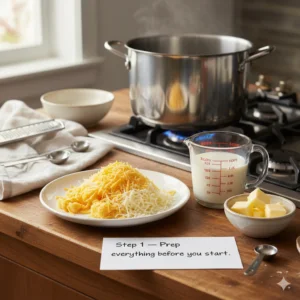
- Grate cheeses and set on a plate; bring to room temperature for 15–20 minutes.
- Measure milk and butter.
- Fill a large pot with water and set it on high heat (we’ll salt it and cook pasta later).
Why: once the sauce is ready, you must move quickly. Mis-timed steps cause overcooking or separation.
My experience: The first time I tried a cheesy pasta in a rush, I added cold cheese to hot liquid and it clumped. Letting the cheese warm slightly has solved this every time.
Step 2 — Boil the pasta (timing is critical)
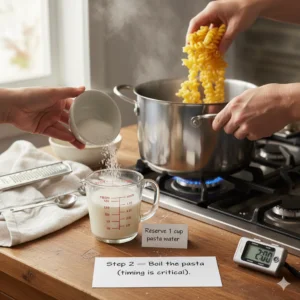
- When the water boils, add a generous pinch of salt (it should taste like seawater). Add pasta.
- Cook to al dente, but remove 1–2 minutes earlier than the package time if you plan to bake. For stovetop finishing, cook to the package’s al dente time.
- Reserve 250 ml (1 cup) of pasta cooking water before draining. This starchy water helps the sauce bind to the pasta.
Common mistake & fix: Overcooking. I once left pasta 3 minutes too long and even a great sauce couldn’t save the mushy texture. Set a timer and taste early.
Step 3 — Make a light roux (stabilizes the sauce)
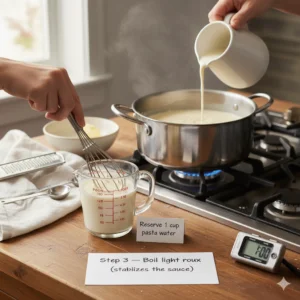
- In a medium saucepan, melt 2 tbsp butter over low heat. Don’t let it brown.
- Add 1 tbsp flour and stir for 1 minute to cook the raw flour taste — this is your roux.
- Slowly whisk in warm milk (use warmed milk, not straight from the fridge) and keep whisking to avoid lumps. Warm milk combines more smoothly with roux.
Why this is important: the roux creates a béchamel-like base that prevents the cheese from seizing and separates less easily under heat.
My tip: I heat the milk in a kettle or microwave for 30 seconds so it’s warm when added. It helps the sauce come together faster and reduces shock to the cheese.
Step 4 — Thicken gently
- Simmer the milk + roux for 2–3 minutes until it thickens slightly — you’re aiming for a thin velvety sauce (not paste-thick).
- Season with salt, pepper, and a pinch of nutmeg (nutmeg complements cheese without being noticeable).
Watch out: If it gets too thick, add a splash of reserved pasta water to loosen it.
Step 5 — Add the cheese carefully (the crucial step)
- Reduce heat to the lowest setting.
- Add grated cheese in small handfuls, stirring gently after each addition until melted and smooth. If the sauce looks too thick, add a spoon of reserved pasta water.
- Never let the sauce boil after adding the cheese; keep it just warm. High heat causes the cheese proteins to tighten and release fat, making the sauce oily or grainy.
My experience: I once ramped heat to “make it faster” and the sauce became stringy and oily. I had to cool it slightly and whisk in warm milk to rescue it — a messy fix. Slow and steady wins.
Step 6 — Combine pasta and sauce
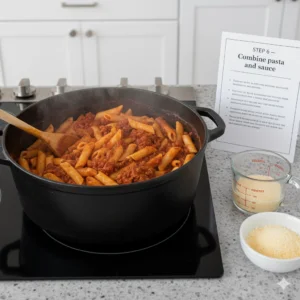
- Add drained pasta to the sauce pan and toss gently until each piece is coated. If you want to bake, transfer to an ovenproof dish now. If you prefer the stovetop, toss and serve immediately.
- Adjust consistency with reserved pasta water: a few tablespoons will help make the sauce cling better.
Serving tip: For a baked top, sprinkle a little extra grated cheese and breadcrumbs before baking at 180°C (350°F) for 10–12 minutes until golden.
Step 7 — Finish and serve
- Finish with freshly ground black pepper and chopped parsley or chives. A tiny drizzle of olive oil can add shine. Serve hot.
I’ve shared my best tips here, but if you’d like to explore more real experiences, you can visit this Quora thread where food lovers have shared their own Swiss cheese pasta tips and tricks!
Common problems, their causes and fixes (real mistakes I’ve made)
I’ll be frank: practice matters. Here are mistakes I actually made and how I fixed them.
Problem: Sauce turned grainy or separated
Cause: Overheating after adding cheese or using pre-shredded cheese with additives.
Fix: Remove pan from heat, whisk in a splash of warm milk slowly to re-emulsify. Next time, grate fresh cheese and melt on very low heat.
Problem: Sauce too thick and clumpy
Cause: Too much roux or too little liquid.
Fix: Slowly whisk in reserved pasta water until smooth.
Problem: Pasta is mushy
Cause: Overcooking in boiling water or letting it sit too long in sauce.
Fix: Cook next time to al dente. If already mushy, serve immediately and avoid baking (baking will dry it further).
Problem: Sauce tastes bland
Cause: Under-seasoned cheese or no salt in pasta water.
Fix: Always salt pasta water well and taste sauce before mixing. Cheese varies in saltiness; adjust accordingly.
Variations — make it your own
Swiss cheese pasta is a flexible base. Try these thoughtful variations.
1) Vegetable-forward (lighter)
- Add 200 g sautéed mushrooms and fresh spinach.
- Replace half the cream with low-fat milk.
Result: more body and freshness, less heavy.
2) Meaty (savory)
- Fry 100 g pancetta or bacon until crisp, fold into pasta before serving.
- The crispy texture contrasts with the elastic texture of melted cheese.
3) Baked gratin
- Combine pasta and sauce, transfer to a baking dish, top with grated cheese and breadcrumbs, bake 10–12 minutes at 180°C until golden.
4) Gluten-free
- Use certified gluten-free pasta and a thickening alternative: replace flour with cornstarch slurry (1 tsp cornstarch + 2 tbsp cold milk). Mix slurry into warm milk and thicken.
5) Sheep or goat influence
- Add 30–50 g of sheep milk or Goat milk cheese for tang. Use sparingly — it changes the flavor profile and can be quite assertive.
Technical tips that make a professional difference
These are small adjustments that consistently improve results.
- Room-temperature cheese melts more evenly.
- Warm the milk before adding to roux to reduce lumps and speed thickening.
- Reserve pasta water — its starch helps bind sauce to pasta.
- Low heat only once the cheese is in. High heat = separation.
- Pre-grate cheese and measure it — avoids last-minute scrambling.
- For a glossy finish, finish with 1 teaspoon of olive oil off heat.
Storage, reheating and shelf-life
Leftovers are common. Here’s how to manage them without ruining texture.
- Store in an airtight container in the fridge for 2–3 days (typical shelf-life for dairy pasta).
- Reheat gently on the stove over very low heat, adding a splash of milk to loosen the sauce. Microwave reheating is okay if you add liquid and stir halfway.
- Avoid reheating at high heat — cheese will seize and become rubbery or grainy.
Comparisons and where Swiss cheese pasta fits on the menu
Swiss cheese pasta sits between classic mac & cheese and more delicate Italian cream sauces. Compared to cheddar-based mac & cheese:
- The flavor is nuttier and more complex (especially with Gruyère).
- The texture tends to be silkier and slightly elastic when done right.
- It pairs beautifully with simple sides from Italian cuisine (a green salad or roasted vegetables) and works well as both a casual family meal and a slightly elevated dinner.
Final tasting notes and serving ideas
Serve swiss cheese pasta hot. For four people, pair with:
- A simple green salad with lemon vinaigrette to cut richness.
- Roasted root vegetables or steamed asparagus.
- A light white wine (Chardonnay or Pinot Grigio) or a fruity red (Beaujolais).
Finish with cracked pepper and chopped herbs. If you added pancetta or ham, offer lemon wedges on the side to brighten the dish.
FAQs About Swiss Cheese Pasta
Can I use only Gruyère?
Yes — Gruyère alone makes an excellent, smooth sauce. Mixing with Emmental gives a milder, creamier effect.
What if my sauce gets oily?
Likely overheated. Remove from heat, whisk in warm milk slowly. Next time, reduce heat and add cheese gradually.
Can I make this ahead?
Yes — keep sauce and pasta separate. Reheat sauce gently, mix with pasta just before serving, or assemble and bake briefly.
Is this a traditional recipe?
It draws from Alpine cheese traditions and adapts them for pasta — it’s a modern, traditional recipe hybrid but faithful to the melting and pairing principles of those cuisines.
Conclusion: Swiss Cheese Pasta
We started by defining swiss cheese pasta, then picked the right traditional cheeses, measured exact quantities for a 4-person meal, and walked through a careful, step-by-step method that avoids the common errors I experienced when I began making cheesy pasta. Remember: control the heat, grate fresh cheese, reserve pasta water, and match pasta shape to sauce.